Certified TV Repair Specialist
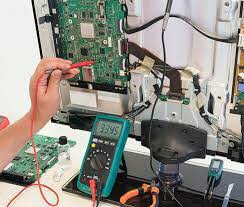
Certified TV Repair Specialist
Home Services Intermediate

Certified TV Repair Specialist

Comprehensive training in television repair and maintenance for modern flat-screen and older CRT models commonly found in township households.

Course Description

Comprehensive training in television repair and maintenance for modern flat-screen and older CRT models commonly found in township households.

Learning Outcomes

After training, students will:
✔ Diagnose common TV problems
✔ Repair power supply issues
✔ Replace screens and components
✔ Service various TV models
✔ Start TV repair businesses

Target Audience

Electronics enthusiasts.
Existing technicians expanding skills.
Entrepreneurs starting repair shops.
Youth seeking technical skills.
Handypersons offering repair services.

10 Modules
68 Lessons
24h 30m

Evolution from CRT to LCD, LED, OLED, and QLED technologies. Understanding panel types, backlighting systems, and TV signal formats.
  • 1.1 - Evolution of Television Technology: From CRT to Modern Displays (25 min)
  • 1.2 - Understanding TV Panel Types: LCD, LED, OLED, QLED Explained (30 min)
  • 1.3 - TV Signal Formats, Resolutions, and Refresh Rates (25 min)
  • 1.4 - Smart TV Platforms and Software Architecture (28 min)
  • 1.5 - Audio Systems and Sound Technologies in Modern TVs (22 min)
  • 1.6 - TV Repair Tools and Essential Test Equipment (25 min)
  • 1.7 - Safety Procedures and High-Voltage Precautions in TV Repair (20 min)

Identifying key boards in a modern TV (power supply, main board, T-con board, LED driver), and understanding their interconnections.
  • 2.1 - Understanding TV Circuit Boards: Power Supply Unit (PSU) (30 min)
  • 2.2 - Main Board (SoC): The Brain of the Smart TV (28 min)
  • 2.3 - T-Con Board: Timing Controller and Panel Driver (25 min)
  • 2.4 - Backlight Inverters and LED Driver Boards (26 min)
  • 2.5 - Power Supply Troubleshooting: Component-Level Diagnosis (32 min)
  • 2.6 - Flexible Flat Cables and Connector Repair (22 min)
  • 2.7 - Using an Oscilloscope for TV Repair Diagnostics (28 min)

High-voltage safety for CRT and LCD TVs, ESD precautions, essential tools (multimeter, oscilloscope, soldering station), and working safely.
  • 3.1 - High-Voltage Safety Protocols and PPE Requirements (25 min)
  • 3.2 - Essential Hand Tools for TV Disassembly and Repair (22 min)
  • 3.3 - Soldering and Desoldering Equipment for Board-Level Repair (28 min)
  • 3.4 - Multimeter Selection and Advanced Usage for TVs (24 min)
  • 3.5 - LED Backlight Tester: Operation and Applications (20 min)
  • 3.6 - Oscilloscope Basics for TV Signal Analysis (26 min)
  • 3.7 - ESD Protection and Safe Component Handling (22 min)

Testing and replacing failed capacitors, fuses, mosfets, and diodes on TV power supply boards. Understanding standby vs. full-power operation.
  • 4.1 - Anatomy of TV Power Supplies: Block Diagram and Signal Flow (25 min)
  • 4.2 - Diagnosing the "Dead TV" Symptom: No Power, No LED (28 min)
  • 4.3 - Troubleshooting Power Cycling and Intermittent Shutdowns (26 min)
  • 4.4 - Capacitor Failure: Identification, Testing, and Replacement (30 min)
  • 4.5 - MOSFET, Diode, and IC Testing in Power Supplies (28 min)
  • 4.6 - Repairing PSU Solder Joints and Trace Damage (22 min)
  • 4.7 - Preventive Maintenance: PSU Recap and Reliability Upgrades (20 min)

Diagnosing LED backlight failures, replacing LED strips, T-con board faults, panel cracks, and image quality issues (lines, blocks, colour errors).
  • 5.1 - LED Backlight Systems: Edge-Lit vs Direct-Lit vs Full-Array (25 min)
  • 5.2 - Flashlight Test and Backlight Failure Confirmation (18 min)
  • 5.3 - LED Strip Testing with LED Backlight Tester (22 min)
  • 5.4 - LCD Panel Disassembly for LED Strip Replacement (30 min)
  • 5.5 - T-Con Board and Panel Driver Failure Symptoms (25 min)
  • 5.6 - Vertical Lines, Horizontal Lines, and Image Artifacts Diagnosis (25 min)
  • 5.7 - OLED Panel Failures: Burn-In, Dead Pixels, and Screen Issues (25 min)

Diagnosing mainboard faults, software update procedures (USB flashing), factory resets, and resolving smart TV application and Wi-Fi issues.
  • 6.1 - Main Board Architecture and Key Components (28 min)
  • 6.2 - Common Main Board Failure Symptoms and Diagnosis (26 min)
  • 6.3 - Voltage Regulators and Power Management ICs on Main Board (25 min)
  • 6.4 - USB Firmware Recovery Methods for Major Brands (28 min)
  • 6.5 - Factory Reset and Service Menu Access Methods (22 min)
  • 6.6 - eMMC Failure: Symptoms, Diagnosis, and Replacement Options (25 min)
  • 6.7 - Main Board Replacement: Selection, Compatibility, and Installation (22 min)

Diagnosing no-sound and distorted sound issues, testing speakers, amplifier ICs, and HDMI/ARC audio pass-through problems.
  • 7.1 - TV Audio Signal Path: From Source to Speakers (25 min)
  • 7.2 - No Sound Diagnosis: Internal Speakers vs External Outputs (25 min)
  • 7.3 - Audio Amplifier IC Testing and Replacement (28 min)
  • 7.4 - Audio Format and HDMI ARC/eARC Troubleshooting (25 min)
  • 7.5 - Bluetooth Audio and Headphone Jack Issues (22 min)
  • 7.6 - Lip Sync and Audio Delay Problems (20 min)
  • 7.7 - Optical (Toslink) and Audio Output Circuit Repair (22 min)

Professional picture calibration, signal tuning, explaining warranty terms, and completing a quality check before returning a TV to a customer.
  • 8.1 - Post-Repair Testing Procedures and Quality Checks (25 min)
  • 8.2 - Picture Calibration: Basics of TV Tuning (28 min)
  • 8.3 - Service Menu Adjustments for Picture Quality (25 min)
  • 8.4 - Customer Communication and Repair Documentation (25 min)
  • 8.5 - Warranty Management and Return Policies (20 min)
  • 8.6 - Safe Transport and Packaging for TV Delivery (20 min)
  • 8.7 - Final Customer Handover and Satisfaction Guarantee (20 min)

This module equips learners with essential research skills including research design, data collection methods (qualitative and quantitative), data analysis techniques, survey development, interviewing skills, ethical considerations in research, and how to apply research findings to improve workplace practices and decision-making.
  • RM 9.1 - Introduction to Research Methods in TV Repair (20 min)
  • RM 9.2 - Using Service Manuals and Technical Documentation (25 min)
  • RM 9.3 - Online Research Strategies for TV Repair (25 min)
  • RM 9.4 - Diagnosing Through Error Codes and LED Blink Patterns (25 min)
  • RM 9.5 - Documenting Repairs and Building a Knowledge Base (25 min)
  • RM 9.6 - Evaluating Information Sources and Avoiding Misinformation (25 min)
  • RM 9.7 - Applying Research Findings to Improve Repair Techniques (20 min)

This module develops critical soft skills essential for workplace success: integrated thinking (connecting ideas across disciplines), logical reasoning and problem-solving, effective verbal and written communication, active listening, emotional intelligence, negotiation techniques, mediation skills, conflict resolution strategies, de-escalation techniques, building consensus, handling difficult conversations, and fostering a collaborative workplace culture.
  • Foundations of Integrated Thinking (60 min)
  • Logical Reasoning and Problem-Solving (75 min)
  • Effective Workplace Communication (65 min)
  • Emotional Intelligence and Conflict Resolution (70 min)
  • Building Consensus and Collaborative Culture (60 min)

Certification Exam

Final examination for Certified TV Repair Specialist certification

Passing Score: 70%
Time Limit: 60 minutes
Attempts Allowed: 3
Camera Required: Yes

To earn your certificate, you must complete all course materials and pass the final exam with a score of 70% or higher.

Enroll in this Course
Certificate included
100 hours content
Downloadable resources
Mobile access
Duration 100 hours
Skill Level Intermediate
Learning Method Self Study
Category Home Services
Modules 10
Total Lessons 68
Last Updated May 2026
Practical skills guarantee